
Businesses across industries keep discussing how to implement AI. Some actually take action, starting to build and operate AI solutions – but there are many others waiting for the right moment, figuring out where to begin. Is it still possible for them to enter the game?
Yes, but newcomers will need a clear view of the economics that make AI different, understanding of where the industry has been and, most importantly, where they can position themselves to capture value. This guide is for them.
Why AI Economics Are Different
Most AI business models today are recombinations of familiar digital models: license, SaaS, platform, marketplace, advertising. Yet AI changes the underlying unit economics via:
Near-zero marginal cost of cognition. Once a model is trained, serving another query costs almost nothing. This is structurally different from professional services (where delivering more requires hiring more) and from most software (where support and infrastructure costs scale with usage). The implication: businesses that find the right delivery model can scale revenue without scaling cost, enabling margin profiles impossible before.
Learning curves and data network effects. AI products can improve automatically as they accumulate more usage data, i.e. more users → better model → better product → more users. This creates compounding advantages for incumbents that don’t exist in static software. It also means that being early in a niche has unusually high strategic value – a data lead is hard to close.
Automation of high-skilled tasks. AI can now handle tasks that previously required expert human judgment, e.g. legal analysis, medical imaging, financial modeling, software engineering. This enables two new revenue model types that barely existed before: outcome-based pricing (where you charge for results rather than access) and agentic models (where software executes multi-step workflows autonomously). Both require near-zero marginal cost to be economically viable – which AI inference now makes possible.
These three fundamental forces open up design opportunities. To navigate them, you’ll need two coordinates.
The Starting Point: Stack Layer and Revenue Point
Before choosing a business model, you need to be clear on two things: where you compete in the AI industry, and how you get paid. Think of these as the axes of your strategic position.
Stack layer: where you compete
- Infrastructure: compute, chips, cloud
- Foundation models and tooling
- Data and labeling
- Application SaaS and vertical solutions
- Services, integration, and business process outsourcing (BPO)
- Ecosystem platforms and marketplaces
Revenue logic: how you get paid
- One-off license or hardware sale
- Subscription (per seat, per organization)
- Usage-based / token- or call-based pricing
- Outcome- or performance-based fees
- Revenue share / take rate
- Advertising / cross-subsidy
The hardest task might be to choose the combination deliberately – the intersection of these two axes is your business model archetype. Before mapping the full taxonomy, it helps to understand how these archetypes actually evolved – because it shows you which positions are already crowded, which are newly open, and where disruption is likely to happen next.
How We Got Here: 70 Years of AI Business Models
AI business models have gone through six distinct eras. Each introduced new technical capabilities, which enabled new delivery mechanisms, which, in turn, unlocked new revenue logics. The pattern is consistent enough to be predictive. Here’s a synthesized map of the six eras:
Several patterns emerge across this history:
Every era began with bespoke delivery and moved toward platforms. Consulting gave way to SaaS, SaaS gave way to APIs, APIs are now giving way to agents. If you are selling a custom AI service today, you should already be thinking about the productized version that will commoditize it – either by building it yourself, or by repositioning before someone else does.
Data became more central with each cycle. The businesses that won in each era accumulated proprietary data that compounded over time and that competitors could not replicate. Model quality is a temporary advantage – proprietary data is a structural one.
Infrastructure-layer players always had the ability to absorb adjacent niches. This is not new. But in the current era, the speed of model improvement and breadth of capabilities make this risk more acute than in any previous cycle. Whoever controls the ‘AI water pipe’ – the foundation model infrastructure – can reset competition at any moment.
Sceptics will note that the fundamental niches have largely been taken. That’s true. But it doesn’t mean the game is over – it means you need to be more strategic about where you enter. There is still significant value to be captured, particularly at the application and services layers, and in verticals where domain expertise and trust matter more than raw model capability.
With this in mind, the full taxonomy of current AI business models makes more sense. These emerged naturally from the combination of different stack positions and revenue logics, refined by market competition over decades. The 20+ archetypes are presented below (DM us for the full deck with detailed descriptions).
The 20+ Archetypes: AI Business Model Map
Note that most of the archetypes on the slide might be irrelevant to your organization. That’s fine. The point is to scan the full design space, not to implement it all.
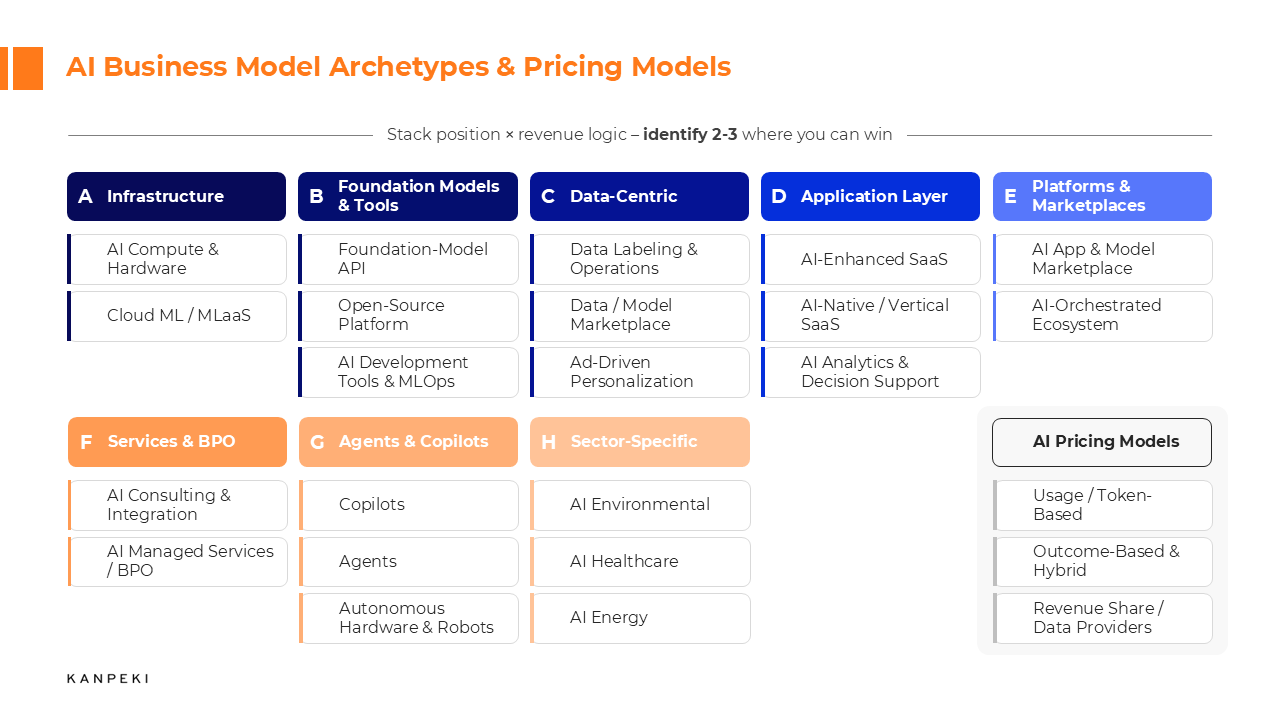
Try to identify the 2-3 archetypes where your existing assets, data, domain expertise, or customer relationships give you a genuine right to win – then act before consensus forms around them.
The Five-Step Action Plan
Frameworks are only useful if they lead to decisions. You don’t need a large budget or a team of ML researchers to start. Here is how to translate the design space, the history, and the archetype map into a concrete strategy for your organization.
Step 1: Pick your position in the stack
Are you building infrastructure, models, tools, applications, or services? This determines your cost structure, competitive exposure, and margin ceiling. Be honest about where you actually sit today – not where you want to be. Infrastructure is capital-intensive with winner-take-most dynamics, applications require domain expertise and distribution, services – execution and trust, and platforms need network effects before they become defensible.
Step 2: Identify your value logic
What does AI actually do for your customers? Five primary value logics cover most cases: automation (removing repetitive or high-volume work), personalization (tailoring outputs to individuals at scale), creativity (generating new content or options), autonomy (executing multi-step tasks without supervision), and decision support (improving the quality of human judgment).
This step matters because your value logic points directly toward the right archetypes: automation and autonomy map to agents and BPO models, personalization – to AI-enhanced or AI-native SaaS, decision support fits analytics providers and copilots. Getting this clear before choosing a revenue model saves significant rework later.
Step 3: Choose your revenue logic
Match your revenue model to your value logic and cost structure: subscription for stable, predictable value, usage-based when consumption mirrors value, outcome-based when results are measurable and your cost per unit is low enough to share upside. Most durable AI businesses land on a hybrid: a base subscription for predictability, usage tiers for expansion, and outcome bonuses for high-value workflows.
Step 4: Align with your sector's constraints
Regulation, data access, trust requirements, and procurement cycles vary dramatically by industry, e.g. healthcare favors outcome-based vertical AI but requires compliance investment, financial services offer high willingness to pay but demand auditability, consumer applications allow rapid iteration but face commoditization pressure. Do not build a model optimized for everywhere – the constraints of your sector will naturally push you toward some archetypes and close off others entirely.
Step 5: Build for disruption, not just for today
This might be the most important step many organizations skip. Every major release from OpenAI, Google, Anthropic, or the next entrant has the potential to make an entire category of AI products obsolete overnight – it has already happened repeatedly. Model quality isn’t lasting – it gets commoditized within months.
The durable advantages are: proprietary data that improves with use, deep workflow integration that makes switching costly, network effects that compound as more users join, domain expertise and regulatory trust that takes years to build, and distribution advantages that new entrants cannot easily replicate.
AI is not a single bet. It is a portfolio of experiments run with strategic intent. The organizations that extract the most value will be those who thought most carefully about where to play, why they can win, and what they will do when the ground shifts again.
The whole world is confused now about where AI is going. That’s not a problem, it’s an opportunity – confusion is the environment where well-reasoned, early bets pay off the most.
Let's design those pathways together.